The GameFi industry experienced a defining transformation in 2025, marking the end of its speculative phase and the beginning of a more mature, sustainability-driven cycle. The sharp contraction in token valuations, funding, and project activity reflected a necessary correction rather than a collapse. This reset removed weak projects and unsustainable economic models, allowing stronger platforms to emerge with clearer value propositions.
Despite the downturn, core engagement metrics and user participation trends indicate that the sector remains fundamentally resilient. Developers are increasingly prioritizing gameplay quality, retention, and long-term monetization over short-term token incentives. This shift is aligning GameFi more closely with traditional gaming standards while preserving the benefits of blockchain-based ownership and decentralization.
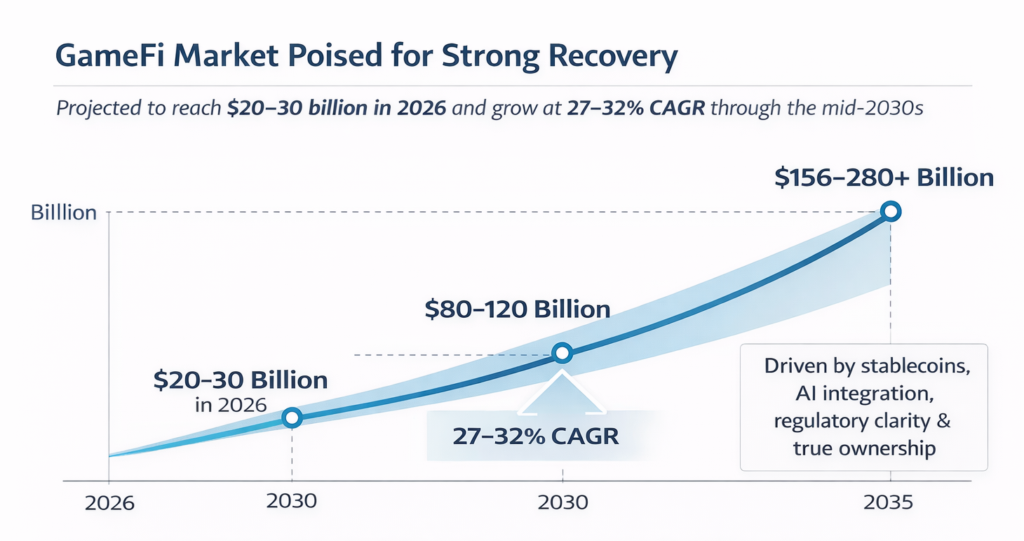
Looking ahead, 2026 represents a critical inflection point. As regulatory clarity improves, infrastructure matures, and technologies like AI and stablecoins integrate into gaming ecosystems, GameFi is expected to re-enter a growth phase. The industry is projected to reach a market size of $20–30 billion in 2026, setting the stage for sustained expansion through the next decade.
1. Market Landscape: 2025 Review and 2026 Outlook
The GameFi market in 2025 underwent a structural reset that reshaped its trajectory. While headline metrics such as market capitalization and funding declined significantly, these changes reflect a transition toward healthier fundamentals rather than a weakening of the ecosystem. The industry is now evolving into a more disciplined and performance-driven environment.
User behavior has also shifted meaningfully. Instead of engaging purely for financial incentives, players are increasingly valuing gameplay depth, community interaction, and long-term progression. This evolution is critical for GameFi’s alignment with mainstream gaming adoption.
2025 Performance Snapshot
The key indicators from 2025 highlight both contraction and underlying resilience:
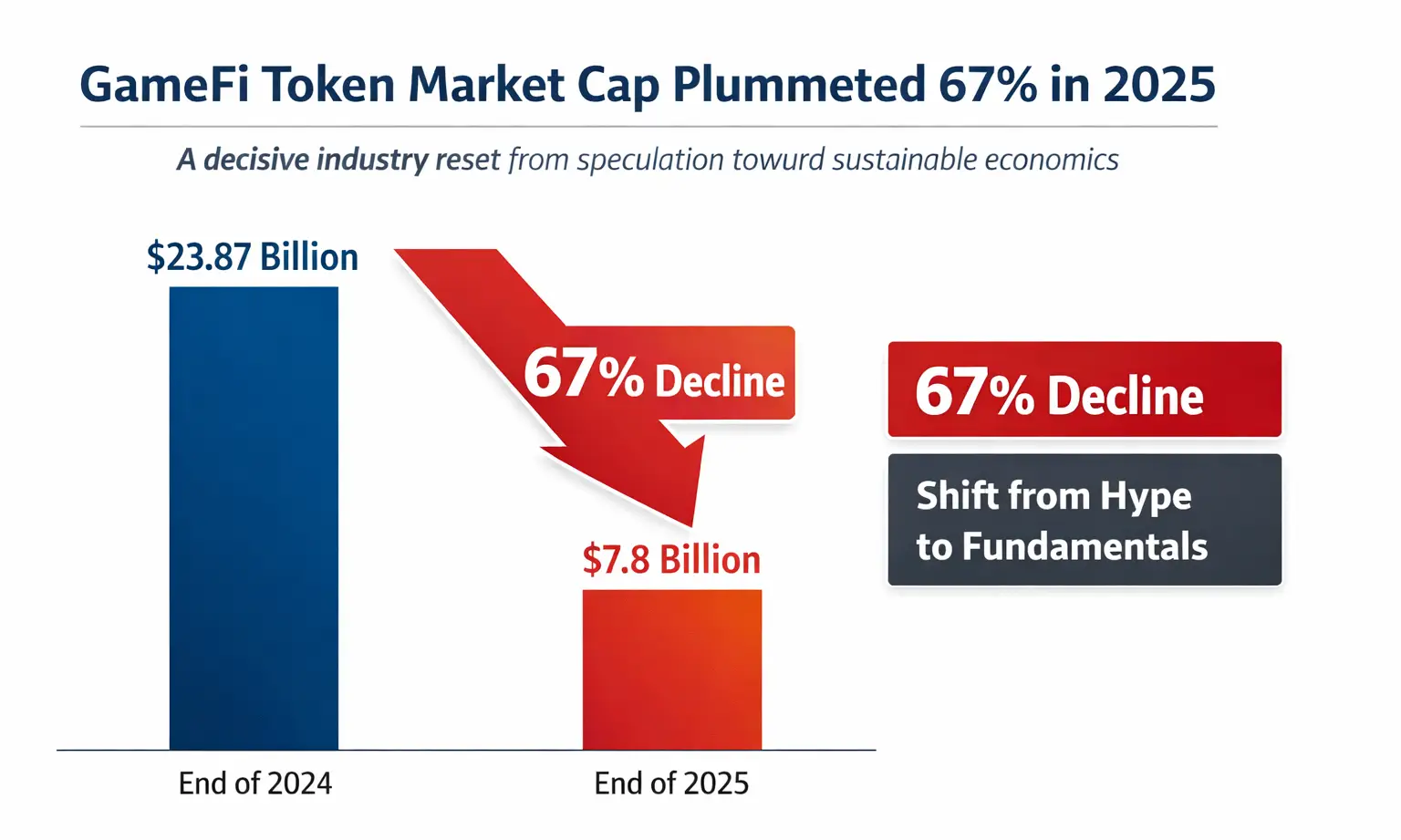
- Token Market Capitalization: Declined to $7.8 billion, representing a 67% drop from 2024
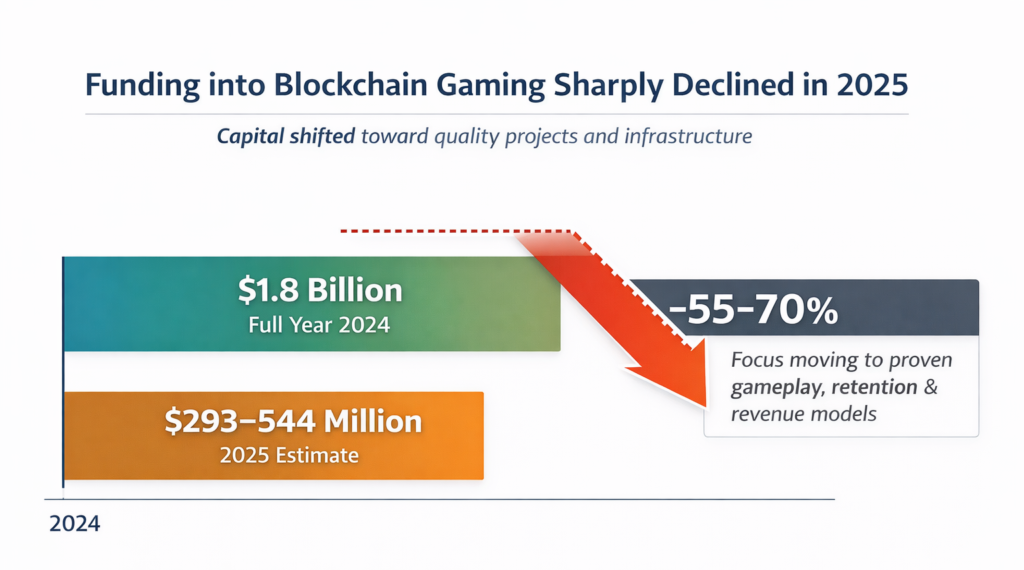
- Funding Activity: Approximately $544 million invested across 114 projects, with a focus on quality over quantity
- User Engagement: Around 4.66 million daily active wallets, with increased engagement per user
- Behavioral Trends: Transactions per user rose by 66%, and ARPPU increased significantly toward traditional gaming benchmarks
These metrics indicate that while speculative capital decreased, user commitment and engagement quality improved.
2026–2035 Outlook
The long-term outlook for GameFi remains highly optimistic, driven by structural and technological advancements. Industry forecasts suggest strong growth potential as the ecosystem matures and integrates with broader digital economies.
- Market Size (2026): Estimated at $20–30 billion
- Long-Term Projection (2035): Expected to reach $156–280+ billion
- Growth Rate: CAGR of 27–32%
Key growth drivers include:
- Expansion of the global gaming audience beyond 3 billion users
- Integration of stablecoin-based payment systems
- AI-driven gameplay personalization and automation
- Improved interoperability across blockchain networks
2. Investment and Funding Intelligence
The funding environment in 2025 reflected a strategic shift rather than a retreat. Investors moved away from speculative token-based projects toward ventures with clear product-market fit, sustainable revenue models, and strong development teams. This transition is creating a healthier investment landscape focused on long-term value creation.
Venture capital firms are increasingly prioritizing infrastructure, tools, and studios capable of delivering high-quality gaming experiences. Early-stage investments dominate the market, indicating confidence in the future potential of the sector despite short-term volatility.
Key Investment Trends
The following trends define the current investment landscape:
- Selective Capital Deployment: Focus on fewer but higher-quality projects
- Infrastructure Emphasis: Increased funding for blockchain tools and AI integration
- Mobile-First Strategy: Growing interest in scalable mobile gaming platforms
- Leading Investors: BITKRAFT, a16z Games, Griffin Gaming, Makers Fund
Investor Strategy for 2026
Investors are aligning their strategies with the evolving market dynamics:
- Prioritizing revenue-generating models over token emissions
- Supporting projects with strong user retention metrics
- Investing in stablecoin-based economies
- Backing hybrid Web2/Web3 distribution models
3. Regional Dynamics
The global distribution of GameFi activity highlights significant regional differences in adoption, infrastructure, and regulatory frameworks. Each region contributes uniquely to the ecosystem, creating opportunities for cross-border collaboration and growth.
While North America leads in institutional investment and infrastructure, Asia-Pacific continues to dominate user adoption and engagement. Emerging markets are also playing an increasingly important role due to mobile-first ecosystems and access to digital financial tools.
Regional Highlights
- North America: Strong infrastructure, institutional backing, and regulatory advancements
- Asia-Pacific: Rapid adoption driven by mobile gaming and cultural acceptance of digital economies
- Europe: Focus on regulatory compliance and skill-based gaming innovation
- Emerging Markets: High growth potential fueled by mobile access and stablecoin usage
Cross-regional interoperability is expected to become a major growth driver, enabling global participation and economic integration.
4. Leading Projects and Ecosystem Players
The next generation of GameFi leaders is defined by their ability to combine engaging gameplay with sustainable economic systems. These platforms are moving beyond experimental mechanics to deliver polished experiences comparable to traditional gaming titles.
Established projects continue to evolve, while new entrants are leveraging advanced technologies to capture market share. The competitive landscape is becoming more sophisticated, with a clear emphasis on quality and scalability.
Key Ecosystem Leaders
- Established Platforms: Axie Infinity, The Sandbox, Decentraland
- AAA Projects: Illuvium, Parallel, Gods Unchained
- Emerging Titles: Wildcard, RavenQuest, EDEN Discovery
These projects demonstrate the industry’s shift toward player-centric design and long-term engagement.
5. Emerging Trends Shaping 2026
Several transformative trends are redefining the GameFi ecosystem and setting the stage for future growth. These trends reflect both technological advancements and changing user expectations.
The convergence of blockchain, AI, and traditional gaming mechanics is creating new opportunities for innovation and scalability. As these trends mature, they will play a critical role in driving mainstream adoption.
Key Trends
- Play-and-Earn Evolution: Focus on gameplay quality with secondary earning opportunities
- Stablecoin Integration: Reduced volatility and improved financial accessibility
- AI Adoption: Enhanced NPC behavior, personalization, and fraud detection
- Regulatory Clarity: Improved compliance frameworks reducing uncertainty
- Interoperability: Cross-chain assets and shared gaming ecosystems
- Hybrid Models: Integration of Web2 distribution with Web3 ownership
6. Challenges and Risk Mitigation
Despite its promising outlook, the GameFi industry faces several ongoing challenges that must be addressed to ensure sustainable growth. These challenges highlight the need for stronger governance, improved transparency, and enhanced user trust.
Addressing these risks is essential for attracting institutional investment and achieving mainstream adoption. The industry must balance innovation with stability to build a resilient ecosystem.
Key Challenges
- Market Volatility: Continued dependence on token price fluctuations
- Regulatory Uncertainty: Evolving legal frameworks and compliance requirements
- Fraud and Security Risks: Scams, bots, and exploit vulnerabilities
- Retention Issues: Difficulty maintaining long-term user engagement
Mitigation Strategies
- Prioritize gameplay-first development
- Implement transparent tokenomics and governance
- Utilize AI for security and fraud prevention
- Engage proactively with regulatory authorities
7. Actionable Insights for Stakeholders
As the GameFi ecosystem evolves, different stakeholders must adapt their strategies to align with emerging trends and opportunities. A clear understanding of market dynamics is essential for success in this rapidly changing environment.
Each stakeholder group—developers, investors, gamers, and publishers—plays a critical role in shaping the future of the industry.
Strategic Recommendations
Developers:
- Focus on gameplay quality and user retention
- Build on scalable blockchain platforms
- Integrate AI and stablecoin systems early
Investors:
- Support projects with proven business models
- Prioritize infrastructure and tool development
- Evaluate regulatory readiness
Gamers:
- Engage with platforms offering sustainable economies
- Value skill-based progression and asset ownership
Publishers:
- Explore hybrid models combining Web2 and Web3
- Partner with experienced blockchain studios
Conclusion: The Renaissance of GameFi
The GameFi industry is entering a new era defined by maturity, innovation, and sustainability. The speculative excesses of previous years have been replaced by a focus on quality, engagement, and real economic value. This transformation is positioning GameFi as a legitimate and enduring segment of the global gaming industry.
As infrastructure improves and regulatory clarity increases, the barriers to adoption will continue to decrease. The integration of advanced technologies such as AI and stablecoins will further enhance user experiences and economic stability.
2026 is not merely a recovery year—it is the foundation for long-term growth and mainstream adoption. The opportunity is significant, and stakeholders who adapt to the new paradigm will be well-positioned to lead the next phase of GameFi evolution.
About GameFi Times
GameFi Times is a next-generation digital publisher delivering gaming news, reviews, insights, funding intelligence and trends across GameFi, Web3, AI, and blockchain gaming for developers, investors, gamers and industry professionals worldwide. Through rigorous data analysis and on-the-ground reporting, GameFi Times equips its global audience with the intelligence needed to navigate and succeed in the rapidly evolving intersection of gaming and decentralized technology.
Media Contact: office@gamefitimes.com