Germany’s armed forces are using Gamescom 2026 to reach one of Europe’s largest concentrations of young, technology-focused consumers as the country pursues a major expansion of its military personnel.
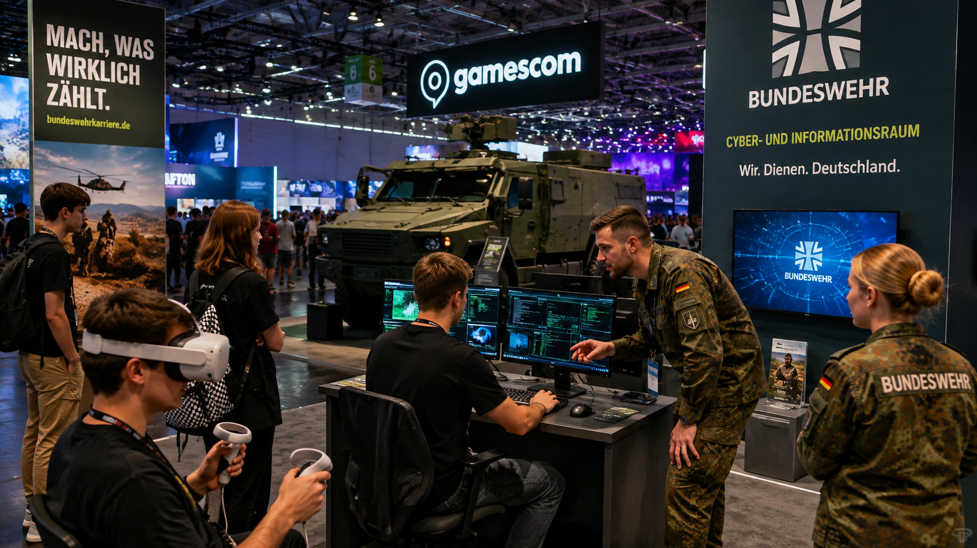
The Bundeswehr has returned to the Cologne gaming convention with cyber demonstrations, virtual reality experiences, military equipment and career counseling. Its presence reflects a recruitment strategy that overlaps with gaming demographics but extends beyond finding people who are simply good at video games.
Germany’s government says the armed forces should grow to more than 260,000 active personnel and 200,000 reservists by 2035, compared with roughly 183,000 active soldiers cited by the government earlier this year. The target puts recruitment at the center of Germany’s wider defense expansion.
Gamescom offers the Bundeswehr access to an unusually relevant audience. The event runs Aug. 26-30 in Cologne, while Gamescom says its 2025 edition attracted roughly 357,000 visitors from 128 countries and 1,568 exhibitors.
The scale illustrates how gaming events increasingly bring together more than game developers and players. GameFi Times has also tracked the expanding role of international industry gatherings in its coverage of the Global Games Show 2026 in Riyadh, where gaming, technology and professional networking similarly intersect.
Bundeswehr uses gaming technology to explain military careers
The Bundeswehr first exhibited at Gamescom in 2016 and has maintained a presence at the event since then, according to Deutsche Welle. Its 2026 exhibition includes an olive-green Caracal military vehicle and computers operated by the Bundeswehr’s cyber personnel, where visitors can participate in supervised hacking exercises.
Other demonstrations use VR to introduce visitors to military occupations, including work aboard naval vessels and roles involving aviation. The booth also features a dedicated area for career consultations.
The technology is not entirely new to the Bundeswehr’s Gamescom strategy. In its own account of its 2024 appearance, the military described using VR, physical challenges and an internally developed game to introduce visitors to the capabilities of its Cyber and Information Domain Service.
That earlier Bundeswehr account of its Gamescom activities also explicitly cautioned against treating military service as a game.
The VR component is particularly suited to a gaming convention because visitors already understand immersive interfaces. GameFi Times’ guide to VR gaming and current headset experiences examines how head-mounted displays have developed into established platforms for interactive simulation and entertainment.
For the Bundeswehr, however, the same technology serves a different purpose: demonstrating occupations and environments that would otherwise be difficult to reproduce on a convention floor.
Being a gamer is not a military qualification
The overlap between gaming and military technology can create an obvious misconception: that proficiency at shooters or strategy games directly translates into suitability for military service.
Bundeswehr officials are pushing back against that interpretation.
Lt. Gen. Robert Sieger, president of the Federal Office for Bundeswehr Personnel Management, told Deutsche Welle that the military needs people who are comfortable with technology, while stressing that actual warfare cannot be equated with playing a shooter.
That distinction matters because Germany’s military recruitment requirements go well beyond gaming ability. Bundeswehr eligibility depends on factors including age, citizenship or residency status depending on the position, physical and mental suitability, education and the requirements of a particular career path.
The Bundeswehr says it had more than 185,000 soldiers and over 81,000 civilian employees as of March 2026, illustrating that its recruitment requirements cover technical and civilian professions as well as conventional combat roles. Official Bundeswehr eligibility information lists occupations ranging from mechanics and IT specialists to medical careers.
Cybersecurity is an especially natural point of contact with Gamescom’s technically skilled audience. Software, networking, information security and other digital capabilities are increasingly relevant to modern armed forces even when they have little connection to conventional ideas about combat.
Gamescom recruitment comes as Germany expands its armed forces
The Bundeswehr’s Gamescom presence has greater significance in 2026 because Germany is simultaneously changing how it builds its military workforce.
Germany’s Military Service Modernisation Act entered into force on Jan. 1. Under the system, 18-year-old men and women receive questionnaires assessing interest and suitability for service; answering is mandatory for men and voluntary for women. From July 2027, men born in 2008 or later will also undergo mandatory medical assessment.
The government continues to prioritize voluntary recruitment, but German law now provides a route toward needs-based compulsory service if personnel targets cannot otherwise be met and parliament approves the measure.
The scale of the expansion explains why a gaming convention matters to military personnel planners. Germany wants at least 460,000 active and reserve personnel combined by 2035, making younger generations an essential recruitment pool rather than simply a marketing audience.
Military recruitment at a gaming show remains controversial
Not everyone accepts that Gamescom is an appropriate venue for military recruiting.
The German Peace Society–United War Resisters has criticized the Bundeswehr’s participation and its use of gaming-oriented language. Peace campaigner Marius Pletsch told Deutsche Welle that the organization objects to attracting young visitors through adventure-focused messaging and argues that military service should not be presented like another leisure-oriented career opportunity.
The Bundeswehr takes the opposite position: that an organization responsible for national defense should remain visible within wider society and explain what military and civilian service actually involves.
That disagreement is likely to persist because Gamescom occupies an unusual cultural position. It is simultaneously a consumer entertainment event, a major international games-industry gathering and a place where employers can reach a large population of young people interested in technology.
Germany’s military presence therefore should not be read as evidence that the Bundeswehr considers gamers ready-made soldiers. Its recruitment strategy is more specific: Gamescom provides access to young people who may already possess an interest in computers, simulation, cybersecurity and complex digital systems.
As Germany tries to add tens of thousands of active personnel over the coming decade, that audience has become increasingly difficult for military recruiters to ignore.