
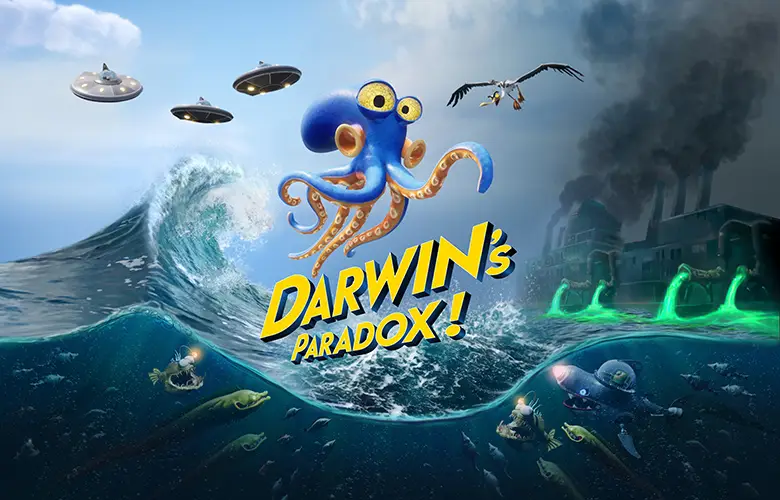
In a gaming landscape dominated by dark, atmospheric puzzle platformers, Darwin’s Paradox arrives with a refreshing twist—replacing dread and minimalism with humor, creativity, and an unlikely hero: a bright blue octopus.
Developed by ZDT Studio and published by Konami, Darwin’s Paradox takes the familiar framework of side-scrolling puzzle adventures and reimagines it through playful mechanics, vibrant design, and a surprisingly layered narrative. While comparisons to genre staples like Limbo and Inside are inevitable, this game carves out its own identity by leaning into personality and accessibility rather than bleak storytelling.
A Fish-Out-of-Water Story With Stakes
The premise is simple but effective. Players control Darwin, an octopus suddenly abducted from the ocean and thrust into a strange industrial world filled with machines, hostile environments, and mysterious forces.
What begins as a survival journey gradually unfolds into something larger. As Darwin navigates factories, laboratories, and urban spaces, the narrative hints at a broader conspiracy tied to humanity itself.
Unlike many puzzle platformers that rely heavily on environmental storytelling, Darwin’s Paradox blends cinematic presentation with light narrative guidance. The tone shifts fluidly between humor and tension, making the experience feel closer to an animated adventure film than a traditional indie platformer.
Gameplay: Creativity Through Biology
Where Darwin’s Paradox truly stands out is in its gameplay design. Instead of conventional platforming abilities, Darwin uses the natural traits of an octopus—resulting in mechanics that feel fresh and inventive.
Players can:
- Climb surfaces using suction-cup tentacles
- Camouflage to blend into environments
- Shoot ink to distract enemies or obscure vision
- Navigate both land and water seamlessly
This combination creates a hybrid experience that blends platforming, stealth, and puzzle-solving. In many sections, players must carefully observe enemy patterns and environmental cues, emphasizing strategy over reflexes.
The stealth elements, in particular, evoke comparisons to tactical games, with Darwin often sneaking past enemies or using environmental cover to progress.
However, unlike more punishing stealth titles, the game maintains a forgiving and approachable design, making it accessible to a broader audience.
Level Design and Pacing
The game’s level design is another highlight. Environments are varied and imaginative, ranging from underwater sequences to sprawling industrial complexes.
Each area introduces new mechanics or twists on existing ones, ensuring that gameplay remains engaging throughout. Puzzles are thoughtfully constructed—challenging enough to require experimentation, but rarely frustrating.
The pacing strikes a careful balance. Moments of tension, such as escaping enemies or navigating hazards, are interspersed with quieter sections that allow players to explore and experiment.
This rhythm keeps the experience dynamic and prevents the repetition that often affects puzzle platformers.
Visuals and Presentation
Visually, Darwin’s Paradox stands apart from its darker counterparts. Instead of muted palettes and oppressive environments, the game embraces color, contrast, and expressive animation.
Darwin himself is a standout character—his exaggerated movements and expressive design bring a sense of life and humor to every interaction. The world around him, while sometimes industrial and foreboding, is filled with detail and personality.
The art direction leans toward a “cinematic animation” style, reinforcing the feeling that players are participating in an interactive film.
Sound design and music further enhance immersion, complementing both the playful and suspenseful elements of the game.
Strengths and Limitations
One of the game’s greatest strengths is its originality. By centering gameplay around an octopus protagonist, it introduces mechanics that feel genuinely new rather than iterative.
The tone is another major advantage. Where many puzzle platformers rely on bleakness, Darwin’s Paradox injects humor and charm without sacrificing tension.
However, the game is not without limitations.
The stealth-heavy sections, while engaging, may feel repetitive for players seeking more action-oriented gameplay. Additionally, the balance between humor and narrative depth may not fully satisfy those looking for a more emotionally intense experience.
Still, these are relatively minor concerns in an otherwise polished and cohesive experience.
Final Verdict
Darwin’s Paradox succeeds by doing something deceptively simple: it makes puzzle platforming fun again. Through creative mechanics, thoughtful design, and a distinctive tone, it offers a refreshing alternative to the genre’s darker trends.
While it may draw inspiration from titles like Limbo, it ultimately stands apart by embracing color, humor, and player-friendly design.
For fans of puzzle platformers—or anyone looking for a unique and charming gaming experience—Darwin’s Paradox is well worth exploring.
For more gaming reviews, insights, and industry analysis, keep visiting GameFi Times regularly.