
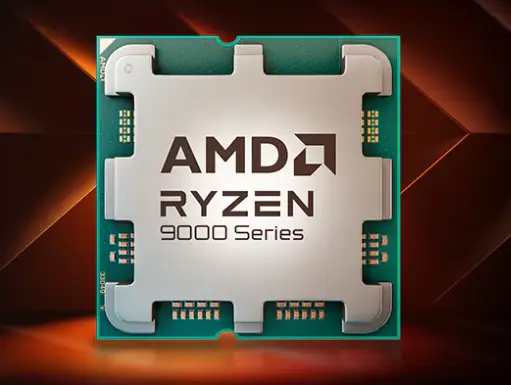
Following the rapid advancements in gaming hardware, Advanced Micro Devices (AMD) has announced its latest flagship desktop processor, the Ryzen 9 9950X3D2 Dual Edition, set to launch on April 22, 2026, as part of its expanding Zen 5-based CPU lineup targeting gamers, creators and AI workloads.
The new chip introduces a major architectural advancement by becoming the first desktop processor to feature 3D V-Cache stacked across both chiplets, delivering a total of 208MB of combined cache. The design marks a significant step forward in AMD’s X3D lineup, which has focused on reducing latency and boosting gaming performance through expanded on-chip memory.
AMD said the Ryzen 9 9950X3D2 is expected to deliver between 5% and 10% performance improvements over its predecessor, particularly in demanding workloads such as rendering, simulation and content creation.
The processor retains a 16-core, 32-thread configuration with a boost clock of up to 5.6GHz and a 200W thermal design power (TDP), reflecting increased performance capacity alongside higher power requirements.
Focus on Gaming, AI and High-Performance Workloads
The launch comes as AMD continues to position its Ryzen 9000 series, built on the Zen 5 architecture and 4nm process technology, as a leading platform for both gaming and productivity.
Expanded cache remains central to AMD’s strategy. By increasing on-chip memory, the company aims to reduce latency and improve responsiveness in data-heavy tasks, including modern game engines, large-scale simulations and AI-assisted workflows.
Industry observers note that the dual-chiplet 3D V-Cache design could narrow the gap between mainstream desktop CPUs and workstation-class processors, enabling advanced workloads without requiring higher-end platforms.
Broader Ryzen 2026 Lineup
Alongside the flagship release, AMD has continued rolling out new processors across its Zen 5 portfolio.
The Ryzen 7 9850X3D, launched in January 2026, targets gaming enthusiasts with an 8-core, 16-thread configuration, a boost clock of up to 5.6GHz and a total cache of 96MB, including 3D V-Cache. The chip operates at a 120W TDP and is positioned as a high-performance option for gamers seeking lower latency and higher frame rates.
AMD has also introduced its Ryzen AI 400 series processors, designed for next-generation AI-powered PCs. These chips feature dedicated neural processing units (NPUs) capable of delivering more than 60 TOPS (trillions of operations per second), supporting advanced on-device AI applications and Microsoft Copilot+ experiences.
Platform Longevity and Ecosystem
All new Ryzen 9000 series processors continue to support AMD’s AM5 socket, reinforcing the company’s long-term platform strategy. The approach allows users to upgrade CPUs without replacing entire systems, while maintaining compatibility with DDR5 memory and PCIe Gen 5 technologies.
This continuity has been a key differentiator for AMD in recent years, particularly among enthusiasts and system builders seeking upgrade flexibility.
Outlook
With the Ryzen 9 9950X3D2, AMD is doubling down on its cache-centric design philosophy while expanding into AI-driven computing. The combination of high core counts, large cache pools and dedicated AI capabilities signals a broader shift toward hybrid workloads where gaming, creation and machine learning increasingly overlap.
The processor’s real-world performance will be closely watched following its release later this month, as competition intensifies in the high-end desktop CPU market in the gaming industry.