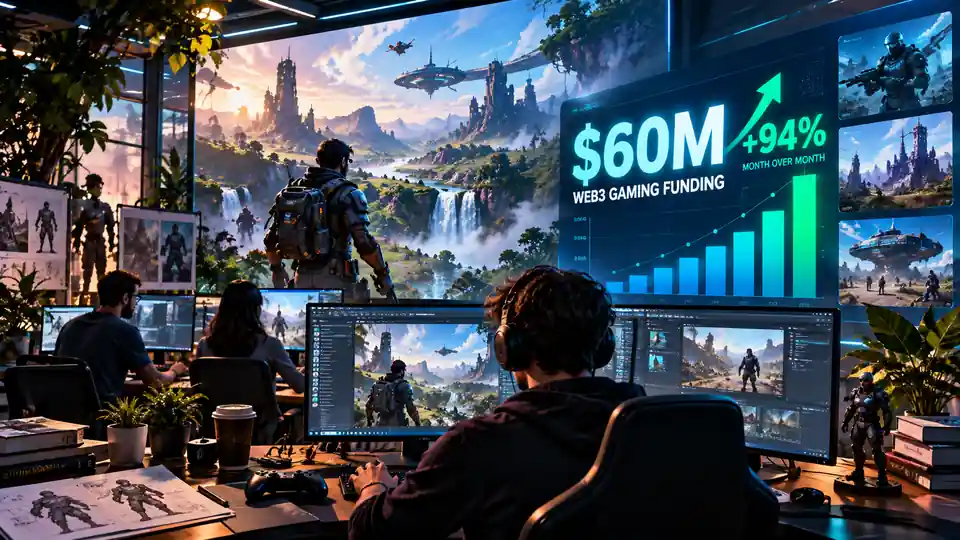
Web3 gaming projects raised $60 million in July 2025, a 94% increase from June after three consecutive months of declining investment. But the headline rebound masks a more concentrated funding market: more than half of July’s capital went to a single game.
Distinct Possibility Studios raised $30.5 million for Reaper Actual, an open-world MMOFPS integrating with Etherlink, the Ethereum-compatible layer-2 network built on Tezos. The round was led by BITKRAFT Ventures and Brevan Howard Digital.
Without that transaction, July’s remaining Web3 gaming investment would have been approximately $29.5 million — roughly comparable with the previous month’s total rather than evidence of a broad doubling in funding.
That distinction makes the numbers more revealing. Investment is returning to parts of blockchain gaming, but investors appear to be concentrating capital around selected teams, established intellectual property and infrastructure rather than indiscriminately funding new GameFi projects.
Reaper Actual accounted for more than half of July’s funding
The Dappradar industry report found that Web3 gaming funding increased 94% month over month to $60 million. Reaper Actual was easily the largest investment, accounting for just over 50% of the month’s total.
The project’s developer, Distinct Possibility Studios, includes veterans of major franchises such as Call of Duty, Halo and World of Warcraft. Reaper Actual is being developed as a persistent open-world shooter combining FPS combat with MMO-scale systems and player-controlled bases.
Other investments were substantially smaller. Gaming community platform STAN raised $8.5 million, with plans to expand in mobile-first markets including India and develop AI-powered personalization and creator tools. Delabs Games raised $5.2 million in Series A financing, taking its reported total funding to $17.2 million.
The concentration matters when interpreting the 94% increase. A funding statistic dominated by one $30.5 million transaction does not mean financing conditions improved equally across the Web3 gaming industry.
Instead, the July data points toward a market where investors are making fewer, more selective bets.
Web3 gaming activity also increased in July
Investment was not the only metric to move higher.
According to reports blockchain gaming reached 4.9 million daily unique active wallets in July, an increase of 2% from the previous month. Gaming was the only decentralized-application category in its report to record month-over-month activity growth.
Unique active wallets are not equivalent to unique human players, however. One person can operate multiple wallets, automated activity can affect blockchain metrics, and many conventional gameplay actions occur without producing an onchain transaction.
The metric is therefore useful for tracking wallet interactions with gaming decentralized applications, but it should not be interpreted as 4.9 million individual daily gamers.
DappRadar’s findings also showed continuing changes in the networks supporting blockchain games. opBNB remained a major source of gaming activity, while Sei moved higher in the rankings. Etherlink added more games, and projects continued moving between blockchain ecosystems in search of distribution, lower transaction costs and infrastructure suited to gaming.
For readers looking beyond financing to the games themselves, GameFi Times’ ranking of Web3 games worth playing in 2026 examines how projects are increasingly being judged on gameplay rather than token mechanics alone.
Investors are putting more emphasis on teams, IP and infrastructure
The July rebound fits a broader change in Web3 gaming financing.
DappRadar analyst Sara Gherghelas characterized the market as increasingly favoring quality over quantity, with capital directed toward projects backed by proven teams, recognizable intellectual property or infrastructure capable of supporting multiple games.
That is materially different from treating the 94% increase as evidence that speculative GameFi investment has broadly returned.
The sector has already experienced the consequences of capital chasing token economies and user-acquisition incentives that could not retain players once financial rewards declined. The harder test for projects funded in the current market is whether they can build games capable of retaining users independently of token prices.
GameFi Times’ explainer on how NFT gaming and digital assets work provides additional context on the ownership and economic systems that distinguish blockchain games from conventional titles.
Infrastructure is another part of the investment thesis. Rather than backing only individual games, investors have increasingly funded technology intended to support multiple developers, games or blockchain ecosystems. That potentially spreads infrastructure investment across more products, although it does not guarantee adoption.
Shrapnel’s $19.5 million financing reinforces the selective-funding trend
Another substantial deal followed the period covered by DappRadar’s July figures.
Seattle-based Neon Machine, developer of blockchain FPS Shrapnel, announced $19.5 million across two investment rounds in August 2025. The latest round was led by Gala Games, with existing investors Griffin Gaming Partners and Polychain Capital participating.
The company said the money would fund continued game development and support Shrapnel’s global rollout, including its expansion into China.
That deal should not be included in July’s $60 million total, but it reinforces the pattern of substantial capital concentrating around projects with experienced teams and products already in development.
The timing also offers useful perspective from 2026. Shrapnel subsequently launched into Steam Early Access on March 12, 2026, meaning investors were financing a product with a defined path toward a playable public release rather than only an early concept.
The 94% increase needs historical context
A month-over-month percentage can exaggerate the appearance of a recovery when the starting point is low.
DappRadar’s $60 million July total was an improvement from roughly $31 million in June, but it remained below March 2025’s $69 million, according to reporting based on the analytics firm’s data.
The longer-term picture is more sobering.
CoinMarketCap and Footprint Analytics previously recorded $909.4 million across 220 Web3 gaming funding events in 2024. Their analysis said investors were already becoming more selective, with increasing attention going toward infrastructure, development tools and projects with stronger fundamentals.
Funding then remained volatile during 2025 rather than moving into a consistent expansion cycle. CoinMarketCap’s year-end review reported more than $147 million in the first quarter, followed by $73 million in Q2 and $129 million in Q3.
Those numbers make July’s surge better understood as a funding rebound within a selective market, not a return to the capital environment that surrounded blockchain gaming during its earlier speculative boom.
What the funding rebound means for Web3 gaming
The strongest signal from July is not simply that Web3 gaming raised 94% more money.
It is where that money went.
Reaper Actual alone absorbed more than half of the month’s investment, while other capital flowed toward gaming communities, established developers and infrastructure. The subsequent $19.5 million financing for Shrapnel provides another example of investors backing a team with an identifiable game and distribution strategy.
At the same time, DappRadar’s wallet data suggests blockchain gaming remained an active part of the decentralized-application market rather than disappearing alongside weaker token-driven projects.
None of those indicators establishes that the funded games will become commercially successful. Venture financing measures investor willingness to provide capital; it does not measure revenue, profitability, player retention or game quality.
For developers and investors, that may be the most important lesson behind the 94% headline. Web3 gaming funding showed that it could rebound, but the distribution of the money suggests the threshold for attracting meaningful capital has become considerably higher.