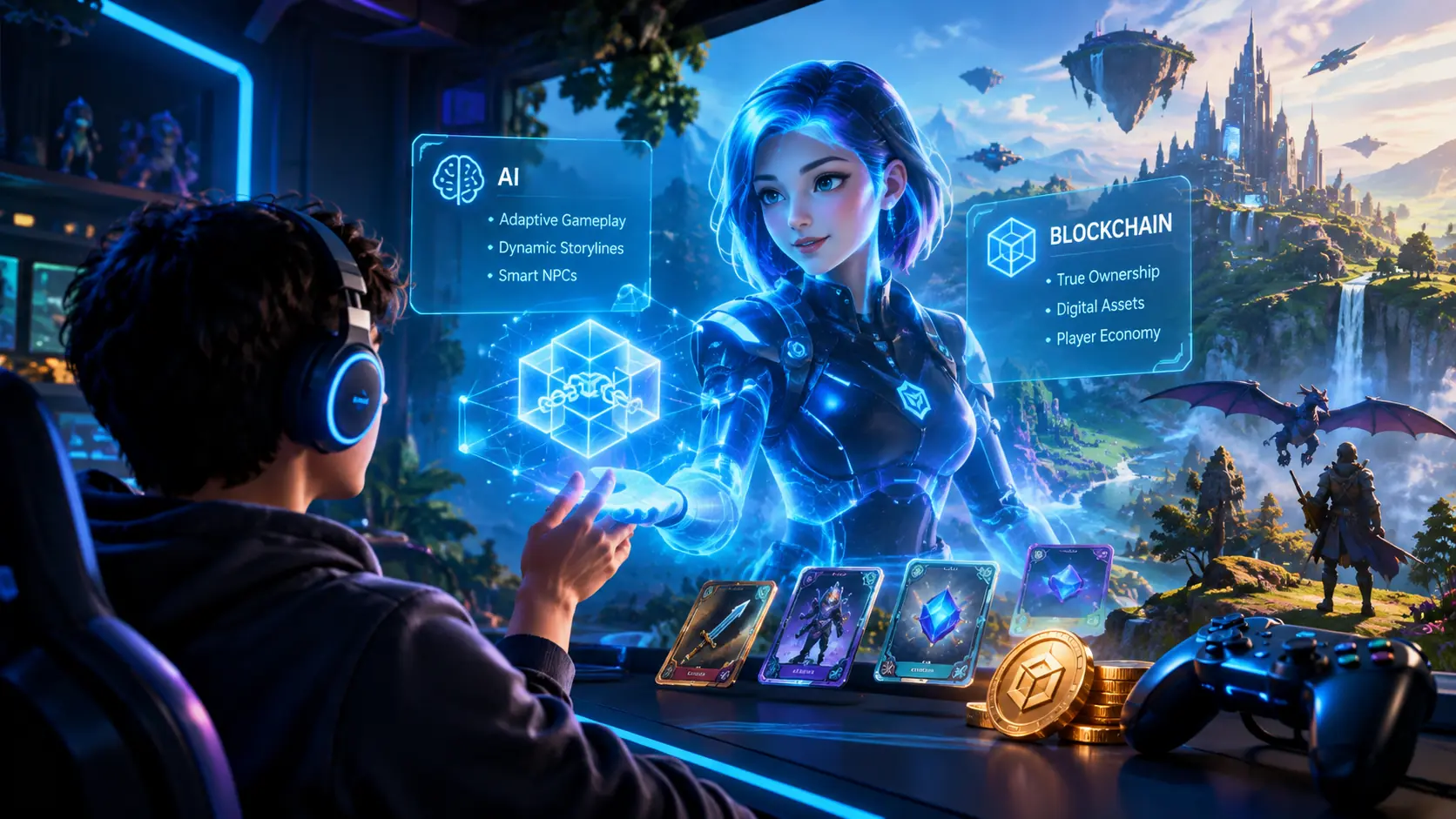
Web3 gaming is moving beyond the play-to-earn model that dominated its early growth. In 2026, developers are increasingly combining artificial intelligence with blockchain to create more responsive characters, adaptive gameplay and personalized experiences. The shift comes as the industry moves away from reward-first game design. AI-powered blockchain games are putting greater emphasis on gameplay while using blockchain as supporting infrastructure for digital ownership and economies.
Why AI-Powered Blockchain Games Are Gaining Attention
For years, blockchain gaming attracted players through tokens, NFTs and financial incentives. While those systems generated significant interest, they also exposed a fundamental problem: financial rewards alone cannot guarantee long-term engagement.
A game still needs compelling mechanics, progression and reasons for players to return.
That is where AI-powered blockchain games are gaining attention. Artificial intelligence can help developers create characters that respond differently to players, opponents that adapt to individual skill levels and game worlds that react to player decisions.
The technology does not automatically make a game better, but it gives developers new tools for creating more dynamic experiences.
AI-Powered Blockchain Games Enter a Market Reset
The shift toward AI comes as blockchain gaming continues to recover from a difficult period.
DappRadar reported that blockchain gaming activity declined 17% quarter over quarter in the second quarter of 2025 to 4.8 million daily unique active wallets. The report also recorded a sharp decline in blockchain gaming investment compared with the previous year.
The figures highlight the industry’s biggest challenge: attracting players is not enough. Developers need to retain them with games that remain enjoyable beyond financial incentives.
This has pushed greater attention toward gameplay quality, accessibility and sustainable game economies.
For new players, GameFi Times’ Web3 gaming explains some of the problems that have affected blockchain gaming projects.
How AI-Powered Blockchain Games Can Improve Gameplay
One of AI’s biggest potential advantages is making gameplay less predictable.
Traditional non-playable characters, or NPCs, generally operate according to predefined behavior. Once players learn those patterns, encounters can become repetitive.
AI systems can potentially change that experience. An AI opponent could adjust its tactics according to a player’s performance, while an AI companion could respond differently based on previous interactions. AI driven systems can also support more personalized conversations and story events.
Web3 developers are already experimenting with these ideas. Partnerships involving blockchain games and AI companies have explored intelligent NPCs and AI agents capable of interacting with players.
The important distinction is that AI needs to contribute meaningful gameplay rather than simply serve as a marketing label.
AI-Powered Blockchain Games Are Moving Beyond Play-to-Earn
The rise of AI also reflects a broader change in Web3 gaming philosophy.
Earlier play-to-earn games often placed financial rewards at the center of the experience. Players were encouraged to complete activities because they could earn tokens or digital assets.
That model created attention but also introduced economic pressures. When token demand weakened or rewards became unsustainable, player activity could fall sharply.
AI-powered blockchain games offer an opportunity to approach the problem differently. Developers can focus on making the game enjoyable first, with blockchain-based ownership and economies operating as supporting features.
This is closer to a play-and-earn philosophy: players should have a reason to enjoy the game even without financial rewards.
How AI-Powered Blockchain Games Could Use Smarter Economies
AI could also play a role behind the scenes.
Blockchain games can contain complex economies involving tokens, NFTs and other digital assets. Poorly designed reward systems can create inflation, oversupply or incentives that become difficult to maintain.
AI-based monitoring could potentially help developers track player activity, asset circulation and other economic indicators and respond to changes more quickly.
However, AI cannot guarantee a sustainable economy.
A game with weak demand, excessive token supply or limited utility can still fail. Sustainable economies require sound design, genuine player demand and carefully structured incentives.
Players evaluating a blockchain gaming project should therefore look beyond its AI features. GameFi Times’ gaming projects provides a framework for examining the fundamentals behind these projects.
AI-Powered Blockchain Games Could Make Blockchain Less Visible
One of the most interesting possibilities is that successful AI-powered blockchain games may make blockchain itself less noticeable.
Mainstream players do not necessarily need to understand wallets, smart contracts or blockchain networks to enjoy a game. Blockchain can operate behind the scenes by supporting digital ownership, asset transfers or persistent game items.
AI could focus on the player experience while blockchain handles infrastructure.
This approach could also reduce one of Web3 gaming’s biggest barriers: complexity. DappRadar has repeatedly highlighted accessibility and reducing friction as important factors in blockchain gaming adoption. DappRadar’s blockchain gaming research
The Risks Behind AI-Powered Blockchain Games
The growing use of AI brings new risks.
The term “AI-powered” can be used loosely, and not every project using AI represents a significant technological advancement. Players should examine what the technology actually does and whether it meaningfully improves gameplay.
There are also technical challenges, including operating costs, reliability and unpredictable AI behavior. Blockchain games must additionally manage digital assets, wallets and potentially volatile token economies.
That means AI should not replace basic due diligence.
What Comes Next for AI-Powered Blockchain Games?
AI is not guaranteed to solve Web3 gaming’s problems, but it gives developers another way to improve player engagement.
The strongest projects may ultimately be those that use AI to make characters, opponents and worlds more dynamic while using blockchain for practical ownership and digital infrastructure.
The industry is still experimenting, so it is too early to declare AI-powered blockchain games the clear winners of Web3 gaming. What is becoming increasingly clear is that the next generation of blockchain games will need to offer more than tokens and rewards.